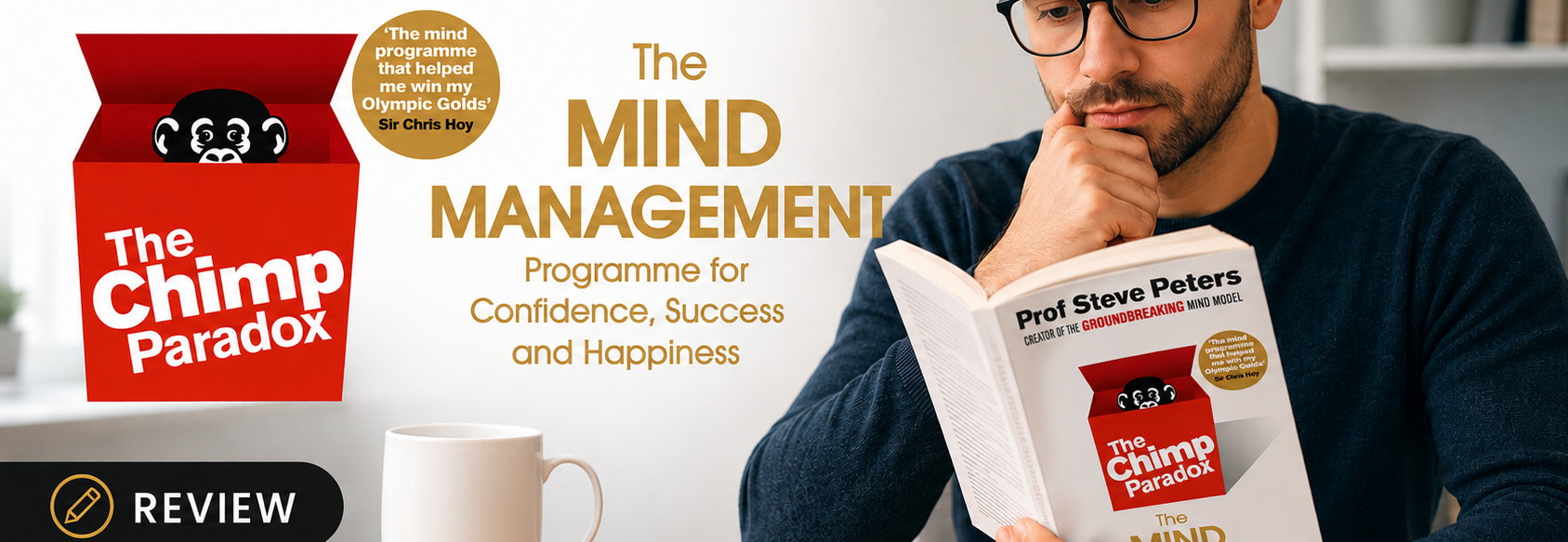
Better Working – The Chimp Paradox book review
May 2026
Modern working life places increasing demands on our attention and ability to manage pressure. Whether it’s navigating busy schedules, collaborating with teams or balancing competing priorities, understanding how we think and respond has become just as important as technical skills in 2026.
Books focused on mindset and performance continue to resonate with professionals across industries and, in a new series, we’ll be exploring some of the most talked-about titles in personal development, leadership, productivity and workplace wellbeing. We’ll be sharing key takeaways and considering how their insights translate into today’s professional environment.
In this blog we take a look at The Chimp Paradox by Dr Steve Peters.
Contact Collaborate for a refreshing take on office space: Modern decor, biophilic design, friendly staff, reasonable prices and flexible contracts designed around your business.
Understanding human behaviour
This interesting title provides a widely recognised and practical framework for understanding human behaviour and improving mental performance in both professional and personal contexts. At the centre of the book is a simple but powerful model of the mind divided into three elements: the ‘Human’, the ‘Chimp’ and the ‘Computer’. The Human represents rational thinking and logical decision-making. The Chimp reflects emotional responses that are fast, instinctive and often reactive. The Computer stores learned behaviours and core beliefs. Peters’ central premise is that many workplace challenges arise when th e emotional Chimp dominates decision-making under pressure. While the model is intentionally simplified, its strength lies in its accessibility and immediate relevance to real-world situations. It offers professionals a practical language for understanding stress responses and decision-making under pressure. For organisations operating in shared or serviced office environments, these insights are particularly valuable. Such spaces bring together diverse teams and communication approaches. The ability to regulate emotional responses and communicate effectively can directly influence productivity and workplace culture.Recognising emotional reactions
Key applications in the book include improving responses to workplace feedback, managing stress during deadlines and reducing friction in team communication. By recognising emotional reactions as distinct from rational thinking, individuals are better equipped to pause and respond more constructively, according to the book. The author also reinforces an important principle in professional development that performance is closely linked to emotional regulation. He believes that developing awareness of automatic thought patterns and behavioural triggers can support stronger leadership and more consistent decision-making.
Practical insights
While the metaphorical structure may feel simplistic for some readers, its effectiveness lies in its practicality. Rather than offering abstract psychological theory, the book provides a usable framework that can be applied immediately in day-to-day working life. Overall, The Chimp Paradox remains a highly relevant resource for professionals seeking to enhance focus and performance under pressure. Its structured approach to mind management makes it particularly applicable to modern workplace environments where adaptability and communication are essential.Contact Collaborate for a refreshing take on office space: Modern decor, biophilic design, friendly staff, reasonable prices and flexible contracts designed around your business.